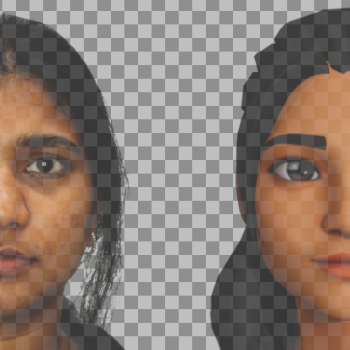
Optical see-through augmented reality (OST-AR) is a technology that allows humans to superimpose graphical elements over the natural environment through a transparent medium. When graphical elements are dark or ambient light is bright, color blending can cause graphical elements to appear transparent. In particular, graphical human faces that have darker skin tones appear more transparent than those with lighter skin tones, introducing both perceptual and social challenges. In this work, a psychophysical experiment assesses observers’ preferred renderings of skin tones in OST-AR. Observers were asked to adjust the lightness of faces superimposed by OST-AR glasses under a bright ambient lighting condition. The stimuli comprised photos of real faces, their corresponding digital avatars, and included those representing the observer and zero-acquaintance targets. We found that observers tended to increase lightness more as faces became darker for both real faces and avatars, but that this pattern was not evident when adjusting photos of their own faces. These results indicate that color preferences for facial color in OST-AR may operate differently depending on familiarity with the target being evaluated, indicating a need for further research involving self-representative stimuli.