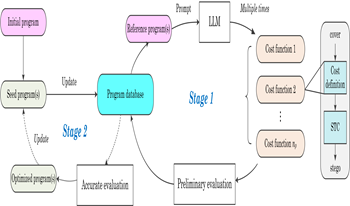
In this paper, we make the first attempt towards defining cost function of steganography with large language models (LLMs), which is totally different from previous works that rely heavily on expert knowledge or require large-scale datasets for cost learning. To achieve this goal, a two-stage strategy combining LLM-guided program synthesis with evolutionary search is applied in the proposed method. In the first stage, a certain number of cost functions in the form of computer programs are synthesized from LLM responses to structured prompts. These cost functions are then evaluated with pretrained steganalysis models so that candidate cost functions suited to steganography can be collected. In the second stage, by retraining a steganalysis model for each candidate cost function, the optimal cost function(s) can be determined according to the detection accuracy. This two-stage strategy is performed by an iterative fashion so that the best cost function can be collected at the last iteration. Experiments show that the proposed method enables LLMs to design new cost functions of steganography that significantly outperform existing works in terms of resisting steganalysis tools, which verifies the superiority of the proposed method. To the best knowledge of the authors, this is the first work applying LLMs to the design of advanced cost function of steganography, which presents a novel perspective for steganography design and may shed light on further research.
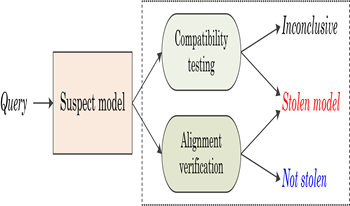
Recent advances confirm that large language models (LLMs) can achieve state-of-the-art performance across various tasks. However, due to the resource-intensive nature of training LLMs from scratch, it is urgent and crucial to protect the intellectual property of LLMs against infringement. This has motivated the authors in this paper to propose a novel black-box fingerprinting technique for LLMs. We firstly demonstrate that the outputs of LLMs span a unique vector space associated with each model. We model the problem of fingerprint authentication as the task of evaluating the similarity between the space of the victim model and the space of the suspect model. To tackle with this problem, we introduce two solutions: the first determines whether suspect outputs lie within the victim’s subspace, enabling fast infringement detection; the second reconstructs a joint subspace to detect models modified via parameter-efficient fine-tuning (PEFT). Experiments indicate that the proposed method achieves superior performance in fingerprint verification and robustness against the PEFT attacks. This work reveals inherent characteristics of LLMs and provides a promising solution for protecting LLMs, ensuring efficiency, generality and practicality.

We present a scheme for securely communicating data over close distances in public settings. Exploiting the ubiquity of cameras in modern day devices and the high resolution of displays, our approach provides secure data communication over short distances by using specialized 2-D barcodes along with an adaptive protocol. Specifically, the barcodes carry public data compatible with their conventional design and additionally private data through specialized orientation modulation in the barcode modules. The latter is reliably decoded when the barcodes are captured at close distances but not from farther distances, a property that we call “proximal privacy”. The adaptive protocol dynamically modifies the strength of the orientation modulation until it is just recoverable by the capture camera. We validate our approach via simulations and by using physical devices to display and capture the specialized barcodes.