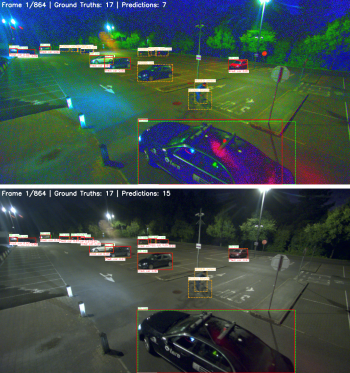
Image signal processors in automotive cameras are typically tuned for human visual perception, yet these same cameras increasingly serve as the primary input to safety-critical object detection systems. In this study, we evaluate the sensitivity of object detection to ISP parameter variation under nighttime conditions. We process raw Bayer data from the nighttime subset of the G-MIND dataset through 21 ISP configurations spanning gain, gamma correction, saturation, bilateral noise filtering, and edge enhancement, and additionally test raw Bayer input with and without gamma correction. For each configuration, we fine-tune four detector architectures representing three design families (single-stage CNN, two-stage CNN, and transformer-based), yielding 92 models evaluated using mAP50−95 per class across five distance bins from 0 to 75 metres. Gamma and gain have negligible effects when models are retrained. Saturation is the most critical parameter: YOLOv8m loses 26.2 mAP points across the saturation range while Faster R-CNN loses only 2.2. Raw Bayer input performs on par with the default ISP for single-stage detectors while eliminating all ISP processing cost, suggesting that a full human-tuned ISP is not optimal for nighttime machine perception. No ISP variant reverses detection degradation with distance. These findings demonstrate that ISP sensitivity is architecture-dependent, that a full human-tuned ISP is not optimal for nighttime machine perception, and that there is scope to develop leaner, perception-aware ISP pipelines tailored to the downstream detector