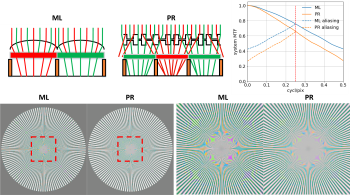
Photon router technology is emerging as a novel approach that replaces microlenses to boost CMOS image sensor signal-to-noise ratio. It provides an approach to solve the signal-to-noise ratio drop associated with the trend of pixel size reduction. To comprehensively understand the photon router image sensors overall image quality, it is critical to study the modulated transfer function and aliasing effect. In this study, we show that photon routers exhibit lower sensor MTF compared to the microlenses due to its higher effective fill factor. Our image simulations show that photon routers present less severe aliasing artifacts compared to the microlenses. We show that it is because lower MTF of photon routers leads to lower aliasing components. Furthermore, we present that the reduced resolution in the photon router image can be effectively compensated through tuning sharpening parameter in the image signal processing, enabling comparable sharpness. Our findings highlight the trade-off between achieving high signal-to-noise ratio and high modulated transfer function for photon routers and provide design insights for next-generation high-performance CMOS image sensors.