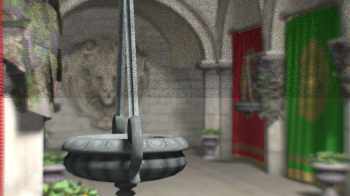
Raytracing in combination with Monte Carlo simulation is an accurate method to simulate optical systems in virtual 3D scenes. Since Monte Carlo simulation relies on random sampling, many samples per pixel need to be computed for a noise-free image, resulting in high computational effort. Even the fastest ray tracers can only trace a few samples per pixel in real-time. A common solution in computer graphics is to compute the image with a few samples per pixel and apply a Monte Carlo denoiser to remove the noise. Since the denoiser alters the image, the question arises to what extent this influences the quality of the simulation. Utilizing “Simulating tests to test simulation”, we measure the SFR curve of a simulation denoised with the NVIDIA OptiX Denoiser and compare it with a highly sampled baseline simulation. Although the image is altered by denoising, using denoised ray tracing simulations yields more realistic results for real-time rendering than a Gaussian blur, but there is a significant texture loss.
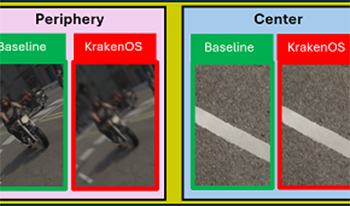
Automotive Simulation is a potentially cost-effective strategy to identify and test corner case scenarios in automotive perception. Recent work has shown a significant shift in creating realistic synthetic data for road traffic scenarios using a video graphics engine. However, a gap exists in modeling realistic optical aberrations associated with cameras in automotive simulation. This paper builds on the concept from existing literature to model optical degradations in simulated environments using the Python-based ray-tracing library KrakenOS. As a novel pipeline, we degrade automotive fisheye simulation using an optical doublet with +/-2◦ Field of View(FOV), introducing realistic optical artifacts into two simulation images from SynWoodscape and Parallel Domain Woodscape. We evaluate KrakenOS by calculating the Root Mean Square Error (RMSE), which averaged around 0.023 across the RGB light spectrum compared to Ansys Zemax OpticStudio, an industrial benchmark for optical design and simulation. Lastly, we measure the image sharpness of the degraded simulation using the ISO12233:2023 Slanted Edge Method and show how both qualitative and measured results indicate the extent of the spatial variation in image sharpness from the periphery to the center of the degradations.