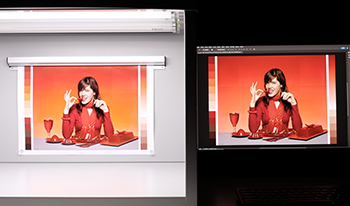
CCFL displays have long been favored in professional applications for their spectral stability and neutral grayscale rendering. In contrast, LED-backlit monitors dominate the current market for their higher efficiency and wider color gamuts. Despite identical calibration settings, spectral differences between the two technologies often lead to significant perceptual mismatches, posing challenges in color-critical workflows such as soft proofing. To investigate individual differences in color perception, we conducted a large-scale psychophysical experiment involving 45 observers. Each observer used custom software to adjust seven color images (white, red, green, blue, cyan, magenta, and yellow) to visually match corresponding printed targets. White image adjustments were performed using RGB gain controls, while chromatic images were adjusted using HSL sliders. From these adjustments, individual color matching functions were derived for each observer. ΔE2000 values were computed to assess spectral curve differences between individuals and across groups. K-means clustering was applied to classify observer patterns. Results showed that individual color matching functions consistently outperformed the CIE 2° Standard Observer in terms of perceptual accuracy, except for magenta and yellow. Interestingly, several K-means cluster-based color matching functions also delivered good performance representing individual color matching functions. Spectral differences across groups were visible directly through color matching functions comparisons, validating the effectiveness of clustering and supporting the use of perceptual group modeling. This study demonstrates that incorporating individual color matching functions can significantly improve cross-media color matching. Observer-specific models built on K-means categories offer a scalable, perceptually based approach to user-aware color management.
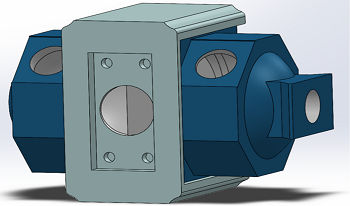
In colour science, colour matching functions (CMFs) are essential for measuring how sensitive the human eye is to various light wavelengths and determining the colour of stimuli in various viewing situations. It has traditionally taken a lot of time and effort to conduct colour-matching studies to describe an observer’s perception of colour. This article presents a simple and compact 3D-printed colorimeter designed to conduct colour-matching experiments. A pilot study was conducted using the colorimeter with four observers participating in a maximum saturation-type colour matching experiment., where they would match spectral lights in the 400-720 nm range to three narrow band LED primaries. The study aimed to assess the accuracy and performance of the system in measuring individual observer CMFs. Results showed that the CMFs of the four observers showed normal characteristics of a colour-normal observer. However, the limited number of measurements per observer may have contributed to the lack of smoothness in the CMFs. The CMFs of one of the observers were compared with Stiles and Burch 1955 RGB CMFs, after normalising to the same primaries. We noted that the red and green functions fell within the expected range, while the blue function showed some unusual characteristics. The limitations of the colorimeter and overall pilot study were also discussed. In conclusion, the colorimeter showed promising results in measuring CMFs, however the limitations need to be addressed to improve matching accuracy. Additionally, further measurements are required to better characterise intra-observer and inter-observer variabilities.