1 MICRON PIXELS133-MEGAPIXEL1st and 2nd FM generation 3D halftoning1/f noise108 Megapixel100 Hue test1-bit matrix completion180 degree images
2
2D to Hologram conversion2-d scale2D metrics2D and 3D video2D-plus-depth video2.5D reconstruction2D DCT2D VIEWS2.5D2D2AFC2-D barcodes2D-TO-3D CONVERSION ARTIFACTS2D printing2.5 D printing2D/3D imaging, high performance computing, imaging systems, efficient computations and storage2.5D PRINTING2x2 On-chip Lens2.5D printing2D AND 3D CONVERTIBLE DISPLAY
3
3D mesh3D shape indexing and retrieval3D refinement3D-color perception3D display3D Measurement3D theater program listing3D Data Processing3D image3D Telepresence3D position measurement of people3D-shooting3DLUT3D DIGITIZATION METHOD FOR OIL PAINTINGS3D Object Detection360-degree images3D Morphable Model3D PRINTING3D face alignment3D MODEL3D video3D-LUT3D/4D Scanning360 panorama3D perception3D stereo vision360-degree image projection3D CAMERAS360 degrees video360-degree art exhibition3D mapping and localization3D/4D Data Processing and Filtering360VR360-video360-degree video streaming3D depth-map3D Saliency3D surface3D Gaussian Splatting3D data processing3D optical scans3D scene classification3D video processing3D objects3D warping3D compression3D Imaging3D model3D TRANSFORMATION360-degree Image3D surface reproduction3D Range Data3D Modeling3D STACK3D Shape Indexing and Retrieval3D/4D DATA PROCESSING AND FILTERING3D Video Communications360-degree videos3D scene flow estimation3D connected tube model3D Tracking3D EDUCATIONAL MATERIAL3D Digital Image Correlation3D image compression3D adaptive halftoning3D-HEVC3D camera3D Halftoning3D Data Sources360-degree content3D Communications3D printing3D PRINTER3D shape3D modelling3D Mapping3D scanning3D capture3D Range Data Compression360 degree images3D affine transformation3D Point Cloud3D Printing3D recovery3D modeling3D skeletal joint point cloud; deep learning; PointNet++ method3D/2D Visuals3D digital halftoning3D Vision3D Immersion3D rigid transformations3D RECONSTRUCTION3D HALFTONING360 IMAGING3D depth sensing3D Curvelet3ARRI footage360° video3D range scanning3D point cloud3D human-centered technologies3D-Anisotropic smoothing3DCNN3D Scene Reconstruction and Modeling3D mesh simplification35MM FILM DIGITIZATION3D projector3D localization3D/4D SCANNING3D-assisted features3D localization and mapping3D digitization and dissemination3D colour Digital Image Correlation3D Print Appearance3D range geometry3D printer3D RECOVERY3D Photogrammetry3D ACQUISITION ARCHITECTURE3D audio3D imaging3D INTERACTION360° VIDEO3A ALGORITHMS360 Video3d mapping360x3D scene capture3-D SHAPE RECOVERY3D DISPLAY3D visual representation3D-high efficiency video coding3D USER INTERFACES3D cinema and TV3D PROFILE360-Degree Video Technology3D TV3D Color Printing360-degree imaging3D CG Image3D Reconstruction3D Range Data Encoding3d3D-printing3D IMAGE3D STIMULI3d video3A Algorithms3D glasses3D COMPRESSION AND ENCRYPTION3D surface structure based halftoning3D3D encoding3D vision3DGS3D MESHES3D Display360-degree3D Gaussian splatting3DSR3D displays3DViewers360-degree video3D communications3D MESH360° STEREO PANORAMAS3D Iterative Halftoning3D-CNN3D Lidar3D Scene Reconstruction3D Compression and Encryption3D VISUALIZATION3DMM3D reconstruction3D SALIENCY3D Meshes3D halftoning3D print3-T pixel3D Video3D-human body detection3D recursive search3D SCENE RECONSTRUCTION AND MODELING3D and 2D3D SHAPE INDEXING AND RETRIEVAL3D Video Conferencing3D Quality360-DEGREE IMAGE360-deg quality assessment3D shape analysis3D MODELLING3-D RECONSTRUCTION3d localization3D RANGE IMAGING3D Image Processing3D object shape3D Compression3D Computer Graphics3D Models
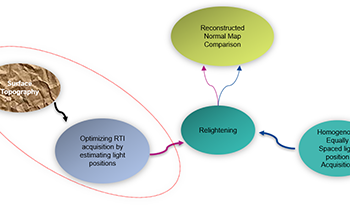
Reflectance Transformation Imaging (RTI) is a technique that provides an enhanced visualization experience. The current acquisition methods for Reflectance Transformation Imaging (RTI) are time consuming and computationally expensive. This work investigates the idea of getting best light positions for RTI acquisition using surface topography. We propose automating the RTI acquisition by estimating the surface topography using deep learning method followed by estimating light positions using unsupervised clustering method. This is one shot method which only needs one image. We also created RTI Synthetic dataset in order to carry out experiments. We found that surface topography alone is not sufficient to estimate best light positions for RTI without putting constraints.