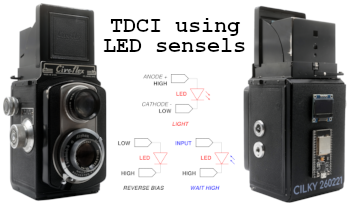
Time domain continuous imaging (TDCI) centers on the capture and representation of time-varying image data not as a series of frames, but as a compressed continuous waveform per pixel. A high-dynamic-range (HDR) image can be computationally synthesized from TDCI data to represent any virtual exposure interval covered by the waveforms, thus allowing both exposure start time and shutter speed to be selected arbitrarily after capture, which also enables extraction of video with arbitrary frame rate and shutter angle. Unfortunately, conventional sensors cannot directly implement TDCI capture, so earlier work focused on postprocessing conventional sensor output to approximate TDCI streams. The current work describes the first direct implementation of TDCI sensing. The sensors discussed here are not image sensor chips, but prototype equivalent circuitry and control logic as low pixel count board-level sensor modules constructed using commodity components. A LED is used to implement each sensel, and each is sampled asynchronously independent of all other sensels by reverse biasing the LED to charge its inherent capacitance and then timing how long the photocurrent takes to reach a fixed threshold voltage. These open source LED-based TDCI sensor modules are used to construct stand-alone TDCI cameras, allowing performance measurements, tweaking of the control logic, and empirically verifying that true TDCI sensing is practical.