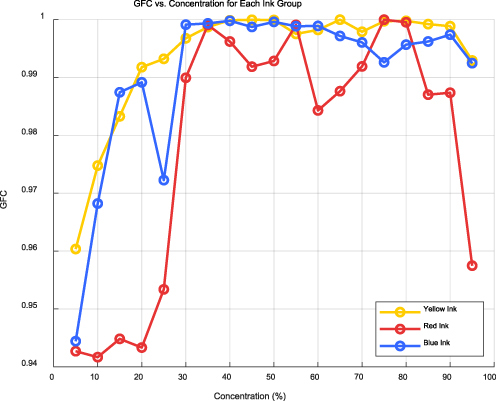
Accurate spot color matching is critical to printing applications, yet constructing an efficient ink base database remains a challenge due to the labor-intensive preparation of ink ladder samples. This study proposes a two-step optimization method to enhance the efficiency and accuracy of spot color prediction using the single-constant Kubelka–Munk (KM) model. The first step employs spectral similarity screening via the Goodness-of-Fit Coefficient to select samples with consistent spectral behavior. The second step optimizes for K/S linearity, identifying concentrations (35% and 40%) that best align with the KM model’s linearity assumption. Five target spot colors, created by mixing yellow, red, and blue base inks, were used to evaluate the method. The K/S values derived from three sample sets—all ladder samples, one-step optimized samples, and two-step optimized samples—were used to predict spectral reflectance and CIE Lab values, with color differences (ΔE) calculated against measured values. The two-step optimized samples achieved the lowest average ΔE value of 3.08 compared to 7.38 for all samples and 4.59 for one-step optimized samples, demonstrating superior accuracy. By reducing the required samples from 19 to 2 per ink, the method significantly enhances efficiency without compromising precision. These findings highlight the importance of spectral consistency and K/S linearity for reliable color matching and offer a practical solution for industrial applications such as packaging and branding.
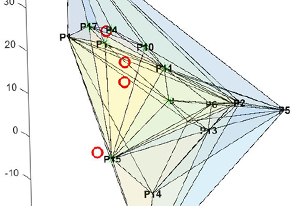
The widespread use of spot color inks in packaging printing has led to the accumulation of substantial remaining spot color inks, resulting in resource waste and environmental concerns. This study proposes a novel utilization method for remaining spot color inks that integrates Delaunay triangulation with the single-constant Kubelka–Munk (K–M) theory to achieve precise and efficient reuse. A color matching database was first established based on the spectral reflectance and colorimetric properties of base and remaining spot color inks. The Delaunay triangulation algorithm was applied in the CIE L∗a∗b∗ space to construct a 3D color gamut structure, enabling the identification of feasible ink combinations through tetrahedral inclusion analysis. Subsequently, an inverse color matching model based on the single-constant K–M theory was developed to optimize ink formulations for given target colors. Experimental validation using multiple remaining spot color targets demonstrated that the predicted and practical color differences (ΔE) remained below 3. This approach not only improves the reuse rate of the remaining spot color inks but also offers a systematic and scalable solution for resource-efficient color management in industrial printing.