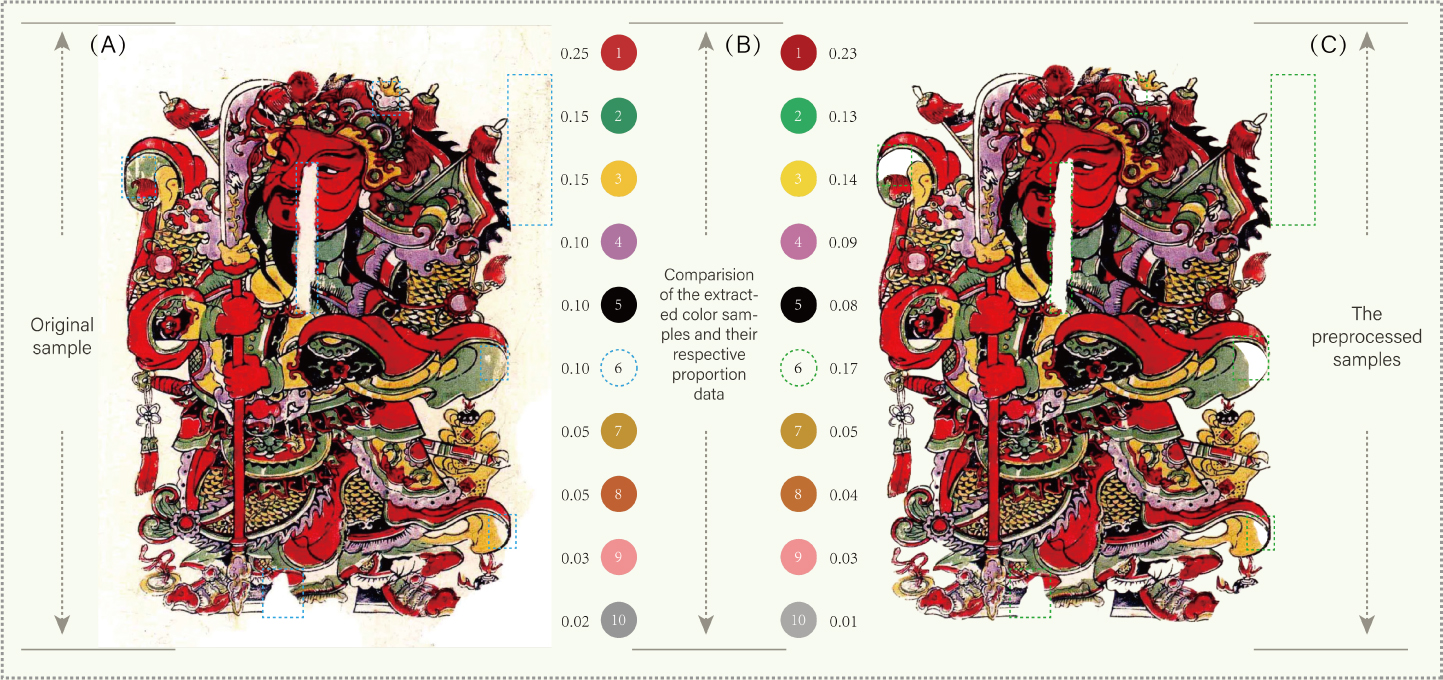
This study investigated the color analysis of Jiangzhou woodblock prints from Shanxi Province and their application in digital visualization design. Jiangzhou woodblock prints, a gem of Chinese folk art, were known worldwide for their distinct engraving style and rich cultural heritage. The study examined the use of different colors in Jiangzhou woodblock prints as well as the underlying cultural symbolism behind them. High-resolution digital images were systematically collected from private collectors, digital archives, and intangible cultural heritage practitioners. To ensure precision, color data were extracted through a dual-model approach using both CIELAB and HSV color spaces. The K-means clustering analysis was employed to identify representative colors and quantify their distributions. A historical color palette was constructed by eliminating perceptually similar hues based on ΔE thresholds, and a novel color matching system was developed according to the principles of color composition and color–emotion correlation theories. The study demonstrated the application of this system in contemporary digital pattern design, highlighting the importance of traditional color systems in cultural creative products. The results showed that the color system of Jiangzhou woodblock prints predominantly featured an organic combination of warm, neutral, and cold tones, with these hues embodying cultural values such as celebration, blessing, and warding off evil. The representative colors collected through clustering techniques revealed combinatorial relationships, which when applied to modern design enhanced visual aesthetics and emotional expressiveness. This research provided theoretical support and practical pathways for the preservation and innovative application of traditional artistic elements through digital design. Nonetheless, challenges remained, such as difficulties in color extraction due to print aging and pigment degradation. Future studies could solve these issues by expanding the sample database, including advanced image restoration technologies to improve the digital application of traditional color systems. This study provides significant color design references for the cultural and creative industries as well as a practical illustration of how digital technology may be used in innovative ways to conserve intangible cultural heritage.

In this paper, we propose an automated adaptive focus pipeline for creating synthetic extended depth of field images using a reflectance transformation imaging (RTI) system. The pipeline proposed detects object regions at different depth levels relative to the camera’s depth of field and collects a most focused image for each. These images are then run through a focus stacking algorithm to create an image where the focus of each pixel has been maximized for the given camera parameters, lighting conditions, and glare. As RTI is used for many cultural heritage imaging projects, automating this process provides high quality data by removing the need for many separate images focused on different regions of interest on the object. It also lowers the skill floor for this image collection process by reducing the amount of manual adjustments that need to be made for focus. Furthermore, this can help to minimize the amount of time that a sensitive cultural heritage object is outside of its ideal preservation environment.