
With the rapid progress of multi-modal large language models (mLLMs), there is growing interest in whether such models can act as judges of image quality. A fundamental question exists, however, as to the ability of such models to distinguish between various levels of image quality attributes, such as sharpness and noise. This work represents one of the first systematic investigations of mLLMs as evaluators in classical paired comparison image quality assessment (IQA) experiments. Prior work in mLLM-based vision has focused on captioning or recognition tasks, whereas our study explicitly frames Gemini 2.0 Flash as a proxy subject in psychovisual testing to establish just noticeable differences (JNDs) for sharpness and noise using the Kodak image quality ruler dataset as stimulus. For both sharpness and noise, the magnitudes of JNDs were found to be proportional to the relative quality of the stimulus. Surprisingly, judgments of individual pairs of images were found to be probabilistic rather than absolute, with more uncertainty observed for sharpness discrimination than noise. Prompt engineering is detailed as is the statistical analysis of results. Understanding the extent to which mLLMs can act as reliable perceptual proxies offers transformative implications for automated IQA, dataset labeling, and adaptive imaging pipelines.
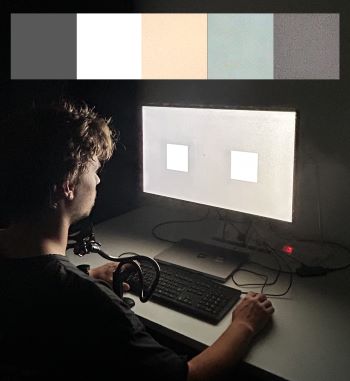
Currently available visual noise estimation algorithms are primarily developed and calibrated using SDR images, which limits their accuracy in representing the actual noise perceived by humans in HDR content. One key factor often overlooked is the luminance adaptation of the observer, especially when there is a significant contrast between the observed patch and its surrounding area. Moreover, the design of existing test charts, combined with increasingly sophisticated local tone mapping algorithms, introduces new challenges. A prominent issue is the presence of gradients in the final image, which significantly affect algorithmic measurements but have minimal impact on human perception: for instance, a patch may register a Just Noticeable Difference (JND) of 6 compared to a perfectly clean patch with zero noise, despite being visually clean and not visibly different. This paper proposes a new direction for visual noise algorithms and sets the foundations for future research. It presents findings on: 1) A new HDR ruler for visual noise assessment. 2) The impact of various factors (CSF, HPF, gradient correction) on algorithm performance. 3) Evaluation of different color spaces to calculate visual noise metrics.