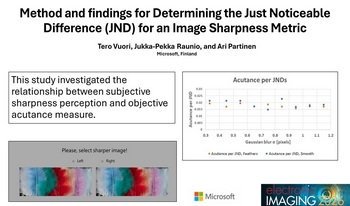
In camera product development, where the goal is to achieve the best possible image quality and user experience, it is necessary to use both objective and subjective test methods. Both methods have their own advantages and disadvantages. The goal of this study is to bring these methods closer together and help the user of objective tests understand the meaning of the test result for the end user. Objective image quality measures are fast and efficient. They form the basis for, for example, camera product comparisons daily basis. The comparison of two camera products is completed quickly and the result is reliable and repeatable. Based on the results provided by the measure, it is possible to rank any camera products easily. However, how big is the noticeable difference between two products for a user if such an objective measure is used? When is the difference significant? Or does the user notice the measured difference at all? In this study, we wanted to get answers to these questions for the acutance measure which is used daily basis. We conducted numerous subjective tests in a controlled lab with carefully chosen stimuli. To include the effect of image content in the study, we used both an image with a lot of detail and a test image with a lot of flat areas and little detail as test samples. Based on these subjective results, we calculated the corresponding Just Noticeable Difference (JND) values for our acutance measure. Results were slightly different to image content with flat areas versus image content with a lot of detail. This study presents methods and results for finding JND values for an objective acutance measure that can be more broadly generalized to all objective acutance measures and, in terms of the method, to all objective measures.

The IEEE P1858 CPIQ Standard is a new industry standard for assessing camera image quality on mobile devices. The CPIQ standard provides test methodologies for evaluating seven image attributes: spatial frequency response, texture blur, visual noise, color uniformity, chroma level, lateral chromatic displacement, and local geometric distortion. In addition, the CPIQ standard provides mathematical transforms between objective metric values and perceived image quality quantifiable in just noticeable differences, and a framework to combine individual attributes into prediction of overall image quality. This study aims at validating the CPIQ set of image quality metrics and the CPIQ prediction of overall image quality. The two key components of the study are objective measurements of image quality in the lab and subjective evaluation of real-world images by human observers. Nine smartphones were used in the study, with the expected camera quality ranging from low to high. The CPIQ methodology was implemented and practiced in an industrial lab, and measurements of the CPIQ metrics were obtained at varying lighting conditions. The subjective evaluation study was performed in a university lab, using paired comparison and softcopy quality ruler as test methods. The results from this study revealed that objective measurements defined in the CPIQ standard are highly correlated with perceived image quality.