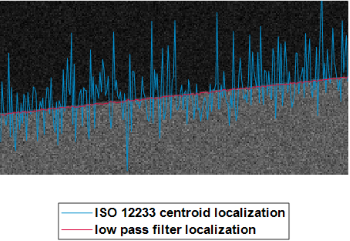
Edge localization plays a critical role in ISO 12233 e-SFR analysis, influencing both sharpness results and downstream information capacity metrics. This paper evaluates the accuracy of the standard centroid, low-pass filter, and matched filter-based localization methods across an ensemble of simulated slanted edge ROIs. Localization errors are quantified by benchmarking each method against ground truth, and their propagation to e-SFR results and information capacity is measured. Findings show that centroid fitting introduces angular bias under noise, leading to a degraded effective response, while low-pass filtering and matched filtering both maintain robust accuracy. These results highlight an under-characterized source of error in standards-based image quality analysis and provide a foundation for improved methods. The results support a closer alignment between edge analysis, information-theoretic models, and emerging metrics such as those proposed in ISO/WD 23654 (Digital Imaging — Information Metrics).

In this article, we propose a comprehensive objective metric for estimating digital camera system performance. Using the DXOMARK RAW protocol, image quality degradation indicators are objectively quantified, and the information capacity is computed. The model proposed in this article is a significant improvement over previous digital camera systems evaluation protocols, wherein only noise, spectral response, sharpness, and pixel count were considered. In the proposed model we do not consider image processing techniques, to only focus on the device intrinsic performances. Results agree with theoretical predictions. This work has profound implications in RAW image testing for computer vision and may pave the way for advancements in other domains such as automotive or surveillance camera.