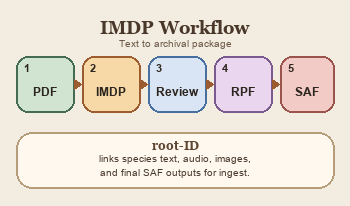
This case study outlines the meta-data curation strategies and workflows employed towards a digital reproduction of an Indigenous print book, Cherokee Earth Dwellers. The data corpus includes multimedia assets in the form of unstructured file formats such as multilingual text, images, audio, and video documents. Five stages guide the digitization process that assist the development of an interactive e-publication from the print book. First, a programmatic approach is utilized to retrieve names of biodiversity species from the pre-print. Second, meta-data for audio, video and image files associated with the print book are weaved together to form an intermediate meta-data package (IMDP). Third, independent meta-data reviewers programmatically validate the resulting IMDP outputs. Fourth, Reproducible Python Files (RPF) are generated to reformat IMDP into Simple Archive Format (SAF) for ingestion into DSpace. Fifth, RPF is published open source to streamline data curation workflows for unstructured multimedia assets. The study concludes with a discussion on the emerging interplay between Generative AI and human curation practices, and its implications for digital publishers, and archival repositories.