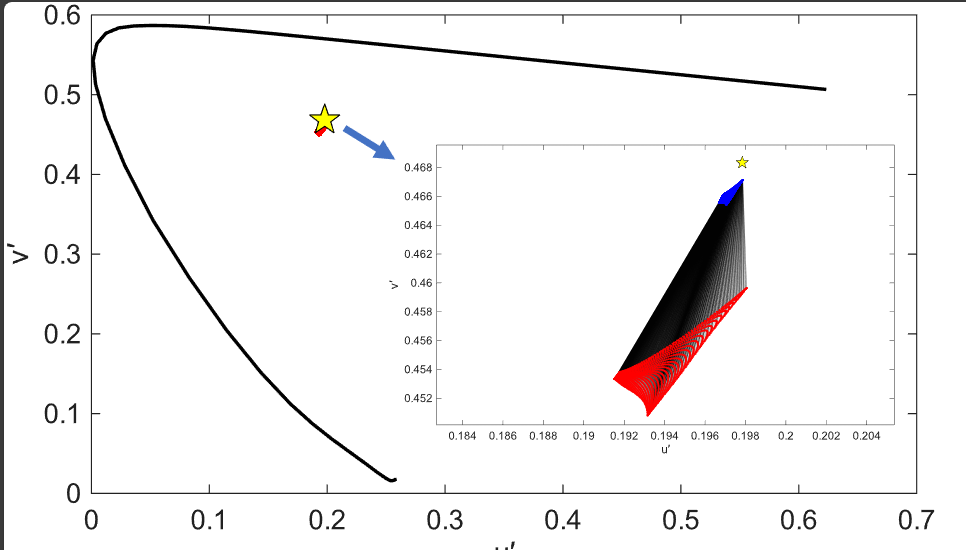
The existing tone mapping operators (TMOs), compress either the high dynamic range (HDR) image luminance or RGB channels and assume uniform adaptation conditions, contrary to human vision that adapts colorfulness under varying adaptation luminance conditions. One of the challenges in tone mapping is maintaining perceptual consistency of both lightness and colorfulness under varying adaptation luminance. Unlike traditional approaches, this work proposes CIECAM16 lightness based, spatially adaptive tone mapping and allows colorfulness according to local adaptation luminance. Furthermore, it uses spatial white point instead of a global one aligning the human perceptual phenomenon. The paper further analyzes the performance of the proposed TMO across various spatial conditions, demonstrating that it preserves local contrast and maintains detail in both highlight and shadow regions while adaptively regulating colorfulness under various adaptation conditions. Hence, this adaptive approach for HDR to standard dynamic range (SDR) mapping offers perceptually faithful representation.
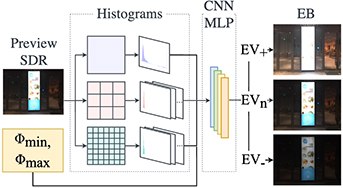
Real-world scenes typically have a larger dynamic range than what a camera can capture. Temporally and spatially varying exposures have become widely used techniques to capture high dynamic range (HDR) images. One of the key questions is what the optimal set of exposure settings should be in order to achieve good image quality. In response to this question, this paper introduces a lightweight learning-based exposure strategy network. The proposed network is designed to optimize the exposure strategy for direct fusion of standard dynamic range (SDR) images without access to RAW-domain images. Unlike most of the direct fusion exposure strategies that primarily focus on tone optimization alone, the proposed method also incorporates the worst-case signal-to-noise ratio (SNR) in the loss function design. This ensures that the SNR remains consistently above an acceptable threshold while enabling visually pleasing tones in lower noise regions. This lightweight network achieves a significantly shorter inference time compared to other state-of-the-art methods. It is a more practical HDR enhancement technique for real-time and on-device applications. The code can be found at https://github.com/JieyuLi/exposure-bracketing-strategy.