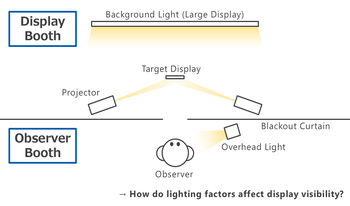
Mobile displays are used across a wide range of lighting conditions. Readability and visual comfort vary greatly depending on the surrounding light environment as well as the luminance of the display. To evaluate effects of the light environment, we developed a two-booth experimental system capable of independently manipulating three factors: the illuminance on display surface, the luminance behind the display and the ambient illuminance in the user's space. Participants viewed black text on a white screen of a smartphone under various light conditions, rating its readability, discomfort glare, and screen comfort across multiple luminance levels. The results demonstrated that all three factors affect visual perception. Especially, the illuminance on the screen had the most powerful effect on readability, while the factors interacted, offsetting each other's effects. In addition, we confirmed that such effects depend on the observer’s light-dark adaptation state. These findings indicate that visual perception of mobile displays can be determined not by individual factors, but by their complex combination.

Glare is an unwanted scattering of light occurring upon its propagation through optical media, whose scarcely predictable, scene-dependent effects are potentially disrupting in terms of accurate scene acquisition. This work starts from the idea of assessing the magnitude of glare in low dynamic range monitor layers during visualization. According to common practice, monitor dynamic ranges are computed as ratios of maximum to minimum luminance values separately acquired on full-screen black and white images. Avoiding the coexistence in the same image of maximum and minimum luminance, this method does not consider the effect of possible intralayer glare. To measure possible intra-layer glare in a monitor, we have displayed images made up with black and white patterns of different sizes. Measuring these different patterns, we detected changes in the luminance of the black regions. At first we explained data as a glare effect. Measuring more carefully each regions through a masking cardboard with a hole, these differences were no more there. It was just glare, not from the monitor layers, but from the lens of the measuring instrument. To further investigate the issue, another setup was arranged whereby two color checkers were stationed behind a dimmable light source aiming away from them both, and directly into the luminance meter. We found that despite light being unable to fall directly on the color checkers, an increase of radiant power was paralleled by an upward drift in luminance values for all examined spots, more so for those lying the closest to a prominent lens flare within the device viewing field. These combined findings show us that no matter the accuracy of the measuring device, luminance information can neither be measured nor displayed correctly in the presence of glare in the instrument.