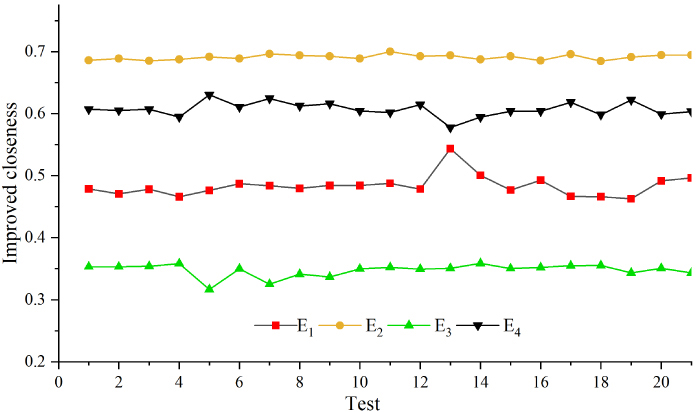
For printing equipment manufacturing enterprises, the selection of an enterprise resource planning (ERP) system involves multiple factors, including function matching degree, technical performance, cost-effectiveness, and others. Therefore, ERP system selection becomes a complex multi-criteria decision-making (MCDM) problem. In this study, a method for ERP system selection suitable for printing equipment manufacturing enterprises is proposed. First, a set of evaluation criteria covering five dimensions—functionality, technicality, implementability, economy, and reputation—is established through literature review. Second, the Fuzzy Analytical Hierarchy Process (FAHP) is used to determine the weights of the evaluation criteria. Then, the gray relational analysis (GRA)-enhanced Technique for Order Preference by Similarity to an Ideal Solution (TOPSIS) method is applied to rank the alternatives. Finally, a dual verification mechanism combining weight perturbation and parameter sensitivity is designed to test the robustness of the ranking results. Experimental results show that Alternative 2 is the best ERP system. Furthermore, key evaluation criteria, such as core functionality coverage and purchase price, are considered to be relatively important. The study demonstrates that this model, through methodological innovation and verification mechanism design, effectively integrates subjective and objective information. It provides a solution that is both scientifically sound and practically applicable for ERP system selection in printing equipment manufacturing enterprises.
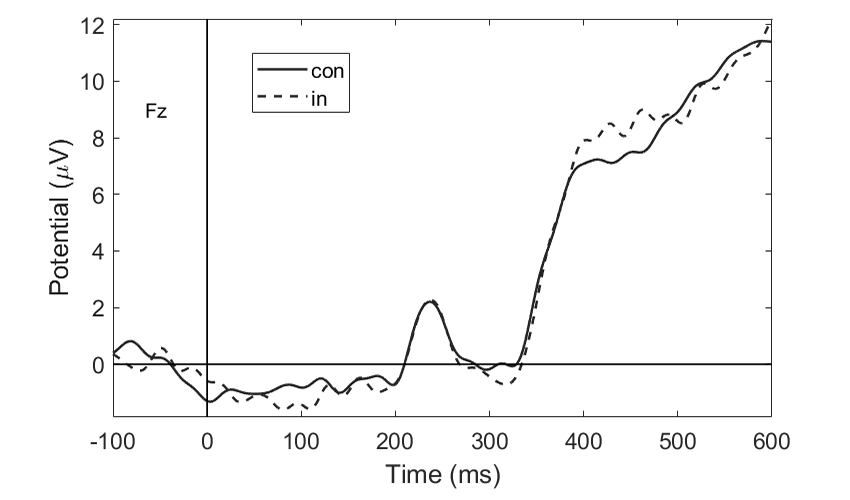
The cross-modal association is a specific connection experienced between stimuli, attributes, or perceptual dimensions. Most previous studies related to the cross-modal association of color and temperature use subjective report methods, and the underlying mechanisms behind this association are unclear. This study used the Implicit Association Test (IAT) paradigm combined with event-related potentials (ERPs) elicited by color stimuli to explore the cross-modal association between color, in terms of hue, saturation, and brightness, and temperature. Cross-modal associations between hue and temperature, as well as saturation and temperature were found. There was no evidence for the existence of a brightness-temperature cross-modal association. Additionally, significant differences in the average N1 amplitudes were observed in the hue IAT task. Significant differences in the average N2 and N400 amplitudes were observed in both the hue and saturation IAT tasks, indicating that both corresponding cross-modal associations have a semantic basis to some degree.