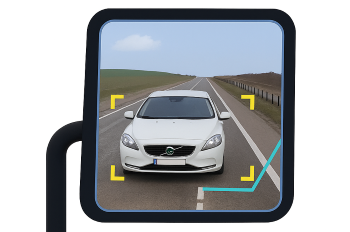
As the automotive industry becomes increasingly digitalized, Camera Monitoring Systems (CMS) are replacing traditional mirrors, offering improved aerodynamics and wider fields of view. However, depth perception remains a challenge, and unclear overlays can reduce driver trust. This study investigates how different CMS augmentations affect distance estimation during overtaking. Thirty participants viewed video clips across three road scenes using one baseline and three augmented interface concepts. They estimated vehicle distances, rated certainty, and reported preferences. The Lines concept, using distance lines and vehicle outlines, produced the most favorable results with the lowest absolute errors and highest clarity and reliability ratings, although it introduced systematic overestimation. The Corner concept led to consistent underestimation but offered some perceived benefits, while the Dashed concept performed similarly to the baseline. The final design builds on the strengths of the Lines concept, with refinements inspired by Corner to enhance visibility and stability. Recommendations include using intuitive depth cues, accessible colors, and well‑timed visual elements. Future research should explore sound cues, symbolic warnings, and long‑term user acceptance.