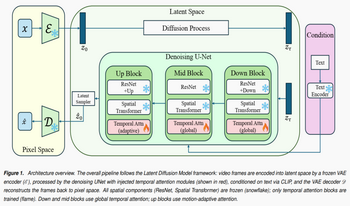
We present a motion-adaptive temporal attention mechanism for parameter-efficient video generation built upon frozen Stable Diffusion models. Rather than treating all video content uniformly, our method dynamically adjusts temporal attention receptive fields based on estimated motion content: high-motion sequences attend locally across frames to preserve rapidly changing details, while low-motion sequences attend globally to enforce scene consistency. We inject lightweight temporal attention modules into all UNet transformer blocks via a cascaded strategy—global attention in down-sampling and middle blocks for semantic stabilization, motion-adaptive attention in up-sampling blocks for fine-grained refinement. Combined with temporally correlated noise initialization and motion-aware gating, the system adds only 25.8M trainable parameters (2.9% of the base UNet) while achieving competitive results on WebVid validation when trained on 100K videos. We demonstrate that the standard denoising objective alone provides sufficient implicit temporal regularization, outperforming approaches that add explicit temporal consistency losses. Our ablation studies reveal a clear trade-off between noise correlation and motion amplitude, providing a practical inference-time control for diverse generation behaviors.
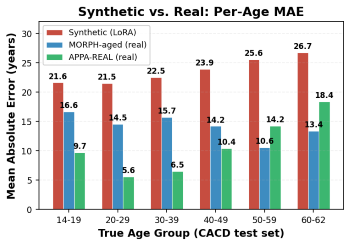
Facial age estimation systems require diverse training data across all age groups, yet existing datasets exhibit significant demographic biases and pose privacy concerns. We evaluate whether Low-Rank Adaptation (LoRA) fine-tuned text-to-image diffusion models can generate age-specific synthetic faces suitable for training age estimation models. We train 199 age-gender specific LoRA models on a standardized compilation of five established datasets and generate a balanced synthetic dataset of 29,850 images. Across four prediction paradigms and seven test datasets, models trained on synthetic data produce substantially higher error than real-data baselines on all regression tasks. Perage analysis on held-out data shows uniformly high MAE (21–27 years) even for age groups with abundant training data, indicating that data imbalance is not the primary cause. Relabeling the synthetic images with an external age estimator reduces MAE by roughly half, confirming that the generated faces are visually plausible but do not depict the intended target ages. These findings indicate that standard LoRA cannot reliably encode age as a semantic attribute in diffusion model outputs.