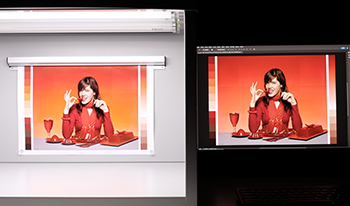
CCFL displays have long been favored in professional applications for their spectral stability and neutral grayscale rendering. In contrast, LED-backlit monitors dominate the current market for their higher efficiency and wider color gamuts. Despite identical calibration settings, spectral differences between the two technologies often lead to significant perceptual mismatches, posing challenges in color-critical workflows such as soft proofing. To investigate individual differences in color perception, we conducted a large-scale psychophysical experiment involving 45 observers. Each observer used custom software to adjust seven color images (white, red, green, blue, cyan, magenta, and yellow) to visually match corresponding printed targets. White image adjustments were performed using RGB gain controls, while chromatic images were adjusted using HSL sliders. From these adjustments, individual color matching functions were derived for each observer. ΔE2000 values were computed to assess spectral curve differences between individuals and across groups. K-means clustering was applied to classify observer patterns. Results showed that individual color matching functions consistently outperformed the CIE 2° Standard Observer in terms of perceptual accuracy, except for magenta and yellow. Interestingly, several K-means cluster-based color matching functions also delivered good performance representing individual color matching functions. Spectral differences across groups were visible directly through color matching functions comparisons, validating the effectiveness of clustering and supporting the use of perceptual group modeling. This study demonstrates that incorporating individual color matching functions can significantly improve cross-media color matching. Observer-specific models built on K-means categories offer a scalable, perceptually based approach to user-aware color management.