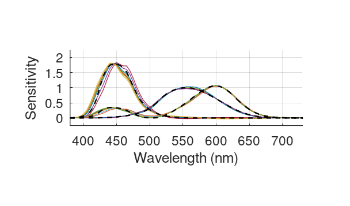
The use of the 1939 standard colorimetric observer for modern display calibration and color management has proven to be problematic in that it doesn’t adequately predict the color matching of actual human observers. Recent research has resulted in the ability to identify physiologically based Cone Fundamental (CF) curves that more accurately predict individual color matching. However, the challenge still remains of adapting CF curves for the use of imagery and color specification based on the 2-degree 1931 standard observer. The use of iccMAX-based color management requires well defined relationships between custom observers and the 2-degree 1931 standard observer to be provided. In this paper, mathematical relationships and principles between cone fundamentals and color matching functions relative to viewing primary lights are outlined. Methods of conversion between cone fundamentals and color matching functions are explored and compared along with the proposed use of Wpt based material adjustment transforms to create color matching functions that provide backwards compatibility with legacy standard observer colorimetry.
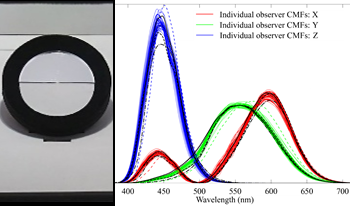
Color matching functions (CMFs) form the foundation of colorimetric calculations. Among color-normal observers, individual differences in visual perception lead to substantial variability in CMFs. While this variability was historically less critical due to the broad spectral characteristics of most stimuli, it has become increasingly important with the growing use of narrowband spectral sources in wide-gamut displays and lighting technologies. As a result, individual observer CMFs have become an important topic of study. Li et al. introduced modifications to Asano’s Individual Colorimetric Observer Model (AICOM+), including the adoption of the 2012 CIE ocular media model and the removal of LMS normalization prior to CMF conversion. A rapid approach for estimating individual observer CMFs—a reduced model with fewer parameters—was also developed to avoid overfitting while maintaining high predictive accuracy. These individualized CMFs were previously validated using achromatic matches. In the present study, the colorimetric accuracy of the individual observer CMFs derived from both the full AICOM+ model and its reduced version was validated, using a rating-based experimental method with the same setup. Nine observers, randomly selected from the original cohort, participated. Their individual CMFs were compared to the CIE 2015 10° CMFs using the rating data. The reduced AICOM+ model yielded more accurate predictions than both the full model and the CIE 2015 10° CMFs for 7 out of 9 observers. Future work will apply recent improvements to individual observer models to evaluate potential further gains in predictive accuracy.
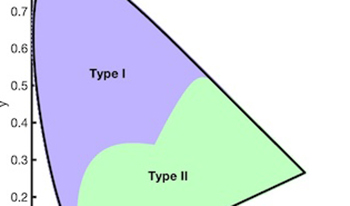
To calibrate a display, a standard color gamut is defined by the target chromaticity coordinates of RGB primaries in CIE 1931 color space, e.g. DCI-P3 and Rec.709. Due to lack of spectral information of such standard target gamut primaries, transformation of target color gamut from CIE 1931 color space to another color space associated with a different observer (defined by a different set of CMFs) is not possible. In this paper, we introduce a novel method for transforming target primary colors from CIE 1931 color space into a new target color space with improved color appearance consistency for typical observers. Our approach represents each primary with a simple spectral definition across the visible range. Results demonstrate that this spectral definition significantly reduces inter-observer variation, thereby offering a practical solution to cross-observer display color space transformation.

In color management applications, it is essential to know the color responses of observers to arbitrary spectral radiances so that objective colorimetric quantities can be determined for use in quantitative color-matching applications. These spectral responses are typically transformed to color matching functions (CMFs) such as for the average CIE standard observer which is commonly used for the computation of various colorimetric, perceptual, and appearance attributes. While the standard CIE CMFs for the average observer have been extremely useful for this purpose, it is well-known that there is significant variation in the spectral response amongst color-normal observers. For color-critical applications, there is widespread interest in determining individual-observer color matching functions with minimal knowledge of field-of-view, age, state-of-adaptation, and other viewing conditions in the actual use-setting. By combining eigenvector analysis of CMF datasets with simple individualobserver metameric color matching exercises and multidimensional reconstruction, individual-observer CMFs can be predicted, transformed, and profiled for color-managed workflow.