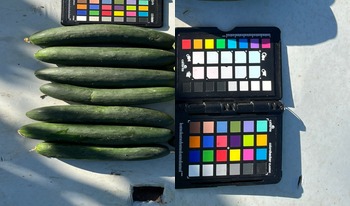
Color-accurate digital imaging is critical for agricultural phenotyping, but the scientific literature predominantly assumes the availability of linear RAW sensor data. In some commercial workflows, only standard 8-bit sRGB JPEG images are available, which poses a significant challenge due to their non-linear encoding and information loss from in-camera processing. This paper presents a robust color correction pipeline designed specifically for such non-linear images captured in uncontrolled outdoor environments. Our core contribution is a novel, per-patch adaptive weighting scheme for least-squares color correction. Instead of deriving a single global correction, our method generates a unique transformation for each patch on an in-frame ColorChecker. This is achieved through a leave-one-out approach where, for each target patch, a model is trained on the remaining 23 patches. Crucially, this training is guided by a weighting matrix customized for the target patch. This adaptive process allows a simple linear model to outperform more complex polynomials. Through systematic evaluation on an unseen test set, we demonstrate this method reduces the mean color error ΔE00 from 11.23 to 3.79, providing a practical and effective solution for real-world agricultural imaging.
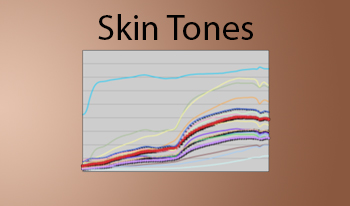
Members of several working groups within the ISO Technical Committee 42 (photography) have begun addressing the important topic of providing guidance for which skin tones to use for image quality testing in various photographic applications. For example, when color patches for skin tones are used in TC42 standards, they should be inclusive and represent a broad range of skin types. Skin tones are present in more than 60% of all captured photographs and therefore need to accurately be corrected in digital cameras, properly displayed and printed on various softcopy and hardcopy devices, and the permanence of the printed colors needs to be determined. During the 2023 plenary meeting of TC 42 in Japan, an ad hoc working group (AHG) was initiated to develop such guidance and report back during the upcoming 2025 plenary meeting in Berlin. The group has investigated existing skin tone studies, including Fitzpatrick, Von Luschan, L’Oreal, PERLA, Monk, Pantone ST, Massey NIS, Verkruysse, Holm and Wueller. It is currently drafting an ISO Technical Report that will document the work and result in recommendations regarding the selection of skin tone color patches and spectra to use for ISO related applications.

Modern digital cameras capture images with a subsampling method via mosaic color filter array (CFA). Of particular interest is the CFA with Cyan-Magenta-Yellow (CMY) color filters. Despite the improvement of the sensitivity, images reconstructed from CMY CFA usually suffer from lower color fidelity compared to the conventional Red-Green-Blue (RGB) color filters. In this paper, we proposed a CMY CFA with novel spectral sensitivities (CMY2.0), which were carefully designed to overcome the shortcomings of previous CMY CFA (CMY1.0). A CMY CMOS image sensor (CIS) with such optimized spectral sensitivities is then realized in order to evaluate the color performance and signal-to-noise ratio (SNR). As a result, the camera equipped with the CMY CFA with proposed spectral sensitivities (CMY2.0) features both an improved sensitivity and a high color fidelity, which is suitable for a wide range of applications, such as low-light photography, under-screen cameras and automotive cameras.