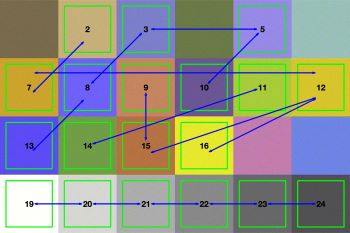
Quantifying the ability of an imaging system to distinguish between colors or signals is fundamental to evaluating camera performance, particularly for applications such as autonomous driving and surveillance. Traditional metrics such as ΔE2000 and Δa∗b∗ provide perceptually motivated color differences but are not designed to account for sensor noise, nor are they invariant to the linear signal processing stages common in imaging pipelines. This paper proposes the use of the Mahalanobis distance as a robust, noise-referred metric for color and signal separation. We demonstrate that the Mahalanobis distance is invariant to affine transformations—including white balance, color correction matrices, and linear color-space conversions—and therefore provides a stable figure of merit regardless of where in the linear pipeline the measurement is taken. We further examine practical considerations including the effects of sensor saturation, nonlinear transformations such as gamma and CIELAB conversion, spatial gradients, region-of-interest size, and target quality. Experimental results are presented for multiple color filter array configurations across a range of illumination levels, demonstrating the utility of the metric for both full signal separation (Yuv) and chrominance-only color separation (uv). The work is conducted within the context of the IEEE P2020 automotive image quality standard.
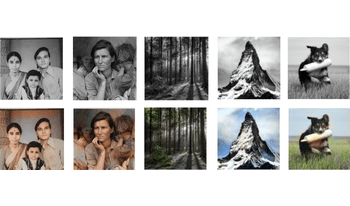
Colorization of grayscale images is a severely ill-posed inverse problem among computer vision tasks. We present a novel end-to-end deep learning method for the automatic colorization of grayscale images. Past methods employ multiple deep networks, use auxiliary information, and/or are trained on massive datasets to understand the semantic transfer of colors. The proposed method is a 38-layer deep convolutional residual network that utilizes the CIELAB color space to reduce the problem’s solution space. The network comprises 16 residual blocks, each with 128 convolutional filters to address the ill-posedness of colorization, followed by 4 convolutional blocks to reconstruct the image. Experiments under challenging heterogeneous scenarios and using the Imagenet, Intel, and MirFlickr datasets show significant generalization when assessed visually and against PSNR, SSIM, and PIQE. The proposed method is relatively simpler (16 million parameters), faster (15 images/sec), and resource-efficient (just 50000 training images) when compared to the state-of-the-art.