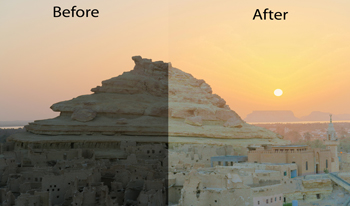
Archaeology-related images are often captured in ambient or non-ideal lighting, leading to illumination non-uniformity. It is a condition in which illumination is unevenly distributed across the image, causing some regions to appear dark while others appear bright. This effect hides details in the dark regions, reducing the usability of such images for analysis, documentation, archiving, display, and 3D modeling. Hence, a refined type-II fuzzy (RTF) algorithm is introduced to improve illumination uniformity. RTF improves uniformity by suppressing bright regions, while boosting dark regions. The experimental results demonstrate that RTF successfully performed its task, delivering better illumination harmonization in the processed images. This allowed for better perception of darkened details and confirmed that RTF can work across different illumination scenarios and scenes.