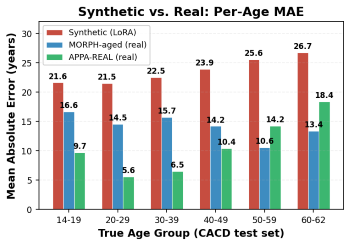
Facial age estimation systems require diverse training data across all age groups, yet existing datasets exhibit significant demographic biases and pose privacy concerns. We evaluate whether Low-Rank Adaptation (LoRA) fine-tuned text-to-image diffusion models can generate age-specific synthetic faces suitable for training age estimation models. We train 199 age-gender specific LoRA models on a standardized compilation of five established datasets and generate a balanced synthetic dataset of 29,850 images. Across four prediction paradigms and seven test datasets, models trained on synthetic data produce substantially higher error than real-data baselines on all regression tasks. Perage analysis on held-out data shows uniformly high MAE (21–27 years) even for age groups with abundant training data, indicating that data imbalance is not the primary cause. Relabeling the synthetic images with an external age estimator reduces MAE by roughly half, confirming that the generated faces are visually plausible but do not depict the intended target ages. These findings indicate that standard LoRA cannot reliably encode age as a semantic attribute in diffusion model outputs.