 Find this author on Google Scholar
 Find this author on PubMed


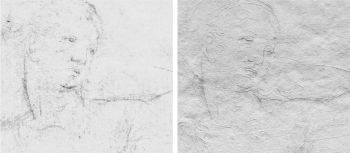
This study considers near-infrared raking reflectance imaging as a way to record incised lines, pricked holes, and other shallow stylus marks in drawings on paper. Such traces can clarify how a design was constructed, revised, or transferred between supports, but they are often difficult to interpret when drawing media visually compete with surface relief. Standard near-infrared reflectance imaging, typically recorded with symmetrical bilateral copy lighting, can reduce the visibility of some drawing media but does not strongly describe shallow deformations in the paper plane. Visible raking illumination emphasizes relief, yet visible media may remain dominant. Imaging experiments on a group of Renaissance drawings suggests that near-infrared, with a raking illumination geometry can help distinguish material deposits from impressed or incised marks, particularly where a stylus line diverges from adjacent media. The method also draws attention to a limitation in technical-imaging terminology: there is no standardized naming convention or prescribed order of terms for describing new imaging techniques or novel combinations of established methods. This paper proposes “near-infrared raking reflectance” as a description of the condition examined here and considers how recording illumination wavelength, geometry, and radiation mode in that order, may support more consistent documentation.
Laura Margaret Ramsey, Rachel Mustalish, "Near-infrared Raking Reflectance Imaging of Stylus Marks in Renaissance Drawings: Distinguishing Media, Relief, and Sequence" in Archiving Conference, 2026, pp 106 - 110, https://doi.org/10.2352/issn.2168-3204.2026.23.1.21