 Find this author on Google Scholar
 Find this author on PubMed


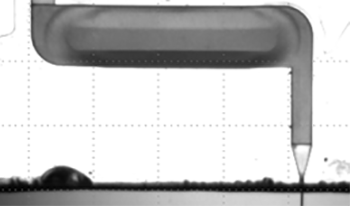
One of the common failures in inkjet heads is ink non-ejection. The causes of non-ejection are generally attributed to nozzle clogging due to ink drying and bubble formation inside the head. However, since it is difficult to directly observe the internal state of the head from the outside, the detailed process leading to this failure has not been fully clarified. To analyze this process, we fabricated a transparent direct-mode head that allows external observation of the nozzle, pressure chamber, and supply channel, and employed a high-speed camera to visualize the ink flow and bubble formation inside the head. The results revealed that bubbles inside the head can be generated through multiple modes: one is bubble ingestion from the nozzle, and the other is vapor bubble formation caused by significant negative pressure in the channel. These bubbles, subjected to pressure oscillations within the ink flow path, repeatedly undergo cycles of growth and collapse, eventually developing into resident bubbles. The process leading to non-ejection is strongly influenced by ink quality. By evaluating different inks, valuable insights can be obtained for the development of high-quality inks.
Shinri Sakai, Ryoichi Bizen, Tsutomu Nishiwaki, Wataru Shiota, Shigeki Takahashi, "Comprehensive Analysis of Inkjet Processes Toward the Future of Inkjet Technology" in Advanced Inkjet Technology, 2026, pp 1 - 2, https://doi.org/10.2352/AIT.2026.1.1.2